The Weight of a Name
The silver drizzle had only just begun to slick the asphalt of the industrial district when the black SUV glided to a halt outside a convenience store whose neon sign flickered with a rhythmic, dying buzz. Silas Thorne stepped out of the vehicle, the cool night air immediately biting through his tailored wool coat as he reached into his pocket for his phone to settle a lingering business dispute. The street was an abandoned corridor of shadows and mist, populated only by the steady, melancholic percussion of raindrops hitting the pavement and the hollow hum of a distant transformer.
He was about to press the screen when a thin, hesitant sound fractured the silence, emerging from the gloom just beyond the reach of the store’s yellowed security lights.
“Sir… excuse me, sir… would you be willing to buy my bicycle?”
Silas turned his head slowly, his instincts sharpened by years of navigating a world where every approach carried a hidden price. Standing a few feet away was a girl who looked far too small for the heavy burden of the night, her fingers white-knuckled as she clutched the handlebars of a rusted, pink frame. The bike was a skeletal thing, scratched and weathered, yet it possessed the unmistakable sheen of an object that had once been someone’s greatest treasure. Rainwater cascaded from her tangled hair, soaking into the fabric of a denim jacket that offered no real protection against the plummeting temperature, and her shoes were held together by little more than hope and grit.
But it was her eyes that forced Silas to remain motionless. They were not the eyes of a child who had spent the afternoon at a park; they were ancient, reflecting a profound weariness that comes from the constant, gnawing presence of anxiety and the weight of a world that expects a child to provide the solutions adults could not find.
Silas felt a rare flicker of curiosity beneath his hardened exterior. “What are you doing out here in this weather without anyone looking after you?”
The girl took a step forward, pushing the bicycle toward him with a physical effort that made her shoulders tremble. “Please… my mother hasn’t had anything to eat in days,” she whispered, her voice barely rising above the hiss of the rain. “I’ve already sold everything else we had in the house that was worth something, so I’m selling my bike now because it’s the last thing left.”
Something fundamental shifted in the atmospheric pressure of the moment. Men of Silas’s stature were generally treated like predatory animals; adults tended to cross the street to avoid his path, and a palpable, icy fear followed him into every room he entered. He was the shadow at the edge of the city’s peripheral vision, the man whose name was spoken in hushed tones to ensure a quiet life. But this child, blinded by the sheer magnitude of her desperation, didn’t care about the rumors or the darkness that clung to his reputation.
“How long has it been since your mother last had a real meal?” Silas asked, his voice dropping to a low, measured register.
The girl hesitated, her gaze dropping to her scuffed sneakers as a flush of shame colored her pale cheeks. “Since the men came to our door,” she finally admitted in a soft rasp.
The line of Silas’s jaw tightened into a hard, dangerous angle. “What men are you talking about?”
The girl glanced over her shoulder, her eyes darting toward the empty alleyways before she leaned in closer to speak. “The men who said my mama owed them for my father’s old debts. They took the furniture, the kitchen supplies… they even took the blankets and the small crib where my baby brother used to sleep.”
Silas felt a cold, focused fury beginning to brew in the marrow of his bones. “They told my mama not to say a word to the authorities,” she continued, her voice gaining a frantic edge. “But I saw the emblem on their car, sir. My mama said the Thorne syndicate had decided to take everything we owned.”
The Echo of the Void
For a moment, the sound of the rain seemed to vanish entirely, replaced by a suffocating, pressurized silence. Silas did not move a muscle, not because he was plagued by a sudden onset of conscience, but because someone had been arrogant enough to use his name as a shield to prey upon those who possessed nothing but the clothes on their backs. He was a man of many sins, but he viewed the exploitation of the destitute as a profound insult to the structure he had built.
Slowly, he reached into his pocket and pulled out his keys, placing the heavy metal fob into the girl’s small, damp palm. “Get into the back of the car,” he commanded, his voice devoid of emotion yet vibrating with an underlying promise of retribution.
Because whoever had authorized this collection was about to discover the difference between a common thief and the man who owned the shadows they moved in.
The House of Hollow Walls
The drive through the darkened streets of the North End was conducted in a heavy silence. The girl—whose name was Clara—sat in the leather seat, still gripping the handles of her bicycle as if letting go would cause the world to dissolve. She pointed a trembling finger toward a narrow lane where the streetlights had long since been shattered, leading them into a neighborhood that the city’s prosperity had forgotten.
Everything about the area spoke of abandonment: the cracked sidewalks, the windows boarded up with rotting plywood, and a silence that suggested the residents had learned that asking for help only invited further tragedy. Silas parked in front of a small, dilapidated bungalow where the front door hung at a precarious, crooked angle. No light escaped the windows; the house was as cold and dark as a tomb.
Clara climbed out of the vehicle with a slow, mechanical precision. “She’s probably sleeping,” she murmured, looking toward the dark porch. “My mama says it hurts less when you’re asleep.”
Those words possessed a jagged edge that cut deeper than any blade Silas had encountered in his decades of ascension. They walked to the door, where Clara retrieved a key from beneath a loose stone in the foundation and turned the lock with a practiced hand.
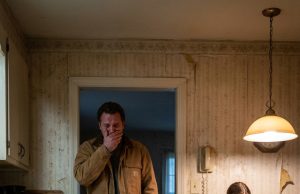
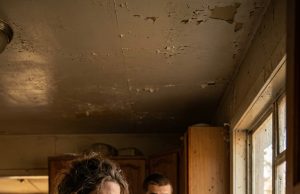
The interior was a vacuum of comfort. There was no sofa to sit on, no table to gather around, and no light to ward off the encroaching night. The air smelled of damp plaster and the metallic tang of hunger. In the far corner of the room, a woman lay curled on the bare floorboards, wrapped in a thin, threadbare blanket that offered no warmth.
Silas stopped in the doorway, his eyes adjusting to the gloom. The woman looked like a porcelain doll that had been shattered and glued back together too many times; she was too thin, her skin a translucent, sickly pale, and her breathing was a shallow, desperate rhythm. She looked as though she were already halfway to the other side.
“Mommy…” Clara whispered, rushing to the woman’s side and kneeling in the dust.
The woman stirred with a weak groan, her eyes fluttering open before they widened in a surge of primal terror at the sight of Silas’s silhouette. “No… please…” she rasped, her voice a dry rattle in the quiet room. “We don’t have a single thing left for you to take… please just leave the girl alone.”
Silas stepped into the room, his footsteps echoing like a judgment on the empty space. “I am not here to take anything from you,” he said, his voice low and steady.
Clara squeezed her mother’s hand with a fierce intensity. “He’s helping us, Mama. He brought us here.”
The woman looked up at him, her expression a mix of confusion and a weariness too profound to sustain an argument. Silas removed his heavy wool coat and stepped forward, draping the expensive fabric over her trembling form. “You need warmth,” he said, his tone brook no dissent. “And you need sustenance immediately.”
He pulled out his phone and made a single, brief call to his private physician and his security detail. “I need a doctor and enough food to stock a kitchen at this address. Now. No questions.”
The Restoration of a Soul
Within twenty minutes, the house was no longer silent. The air began to fill with the savory, rich aroma of warm broth, a scent that felt alien in such a desolate place. The doctor arrived and performed a careful examination, noting that the woman was suffering from the advanced stages of nutritional deprivation. “She is exceptionally weak,” the physician whispered to Silas, “but with proper care and consistent meals, her body will eventually recover.”
Clara remained anchored to her mother’s side, watching with wide eyes as the woman slowly accepted the nourishment. For the first time in what felt like an eternity, there was a pulse of life within those hollow walls. Silas stood by the window, watching the rain begin to taper off, before he turned back to the mother.
“Do you have any specific memory of the men who came here?” he asked.
The woman nodded faintly, her fingers clutching the lapel of Silas’s coat. “One of them had a jagged scar that ran from his ear to his jaw… and he wore a heavy gold signet ring on his right hand.”
Silas’s eyes darkened into two obsidian voids. He didn’t need any further description. He knew exactly which of his lieutenants had decided to supplement his income by shaking down the residents of a forgotten street.
The Accountability of Power
An hour later, in the sterile, high-tech environment of a warehouse on the docks, Julian Vance stood before Silas, drenched in the remnants of the storm and shivering with a fear that transcended the cold.
“I was only looking out for the interests of the organization, Silas—” Julian began, his voice cracking.
“You robbed a family that was already starving in the dark,” Silas interrupted, his voice a terrifying, calm plateau.
“They owed a debt to the old man—”
“They owed us absolutely nothing,” Silas stepped into the light, his presence expanding until Julian seemed to shrink against the wall. “You used my name to justify a theft. You used the fear I cultivated to break a child’s spirit. But you neglected the most important rule of this city.”
Julian swallowed hard, his eyes darting toward the exits. “What rule is that?”
Silas’s voice was a whisper that carried more weight than a shout. “I protect what is mine. And my name belongs to me. It is not a tool for cowards to use on the weak.”
The silence that followed was heavy enough to crush the lungs. Finally, Silas spoke again. “You are going to rectify this. Every single item you removed from that house will be replaced by morning. Not with the old, broken things you took, but with the best quality available. You will ensure the electricity is restored, the pantry is filled, and the furniture is delivered. And if I find a single detail lacking, you will discover exactly how I earned the reputation you tried to hide behind.”
Julian nodded frantically, his bravado having evaporated into a pathetic, desperate compliance. “I’ll do it. I’ll make it right, I swear on my life.”
“You aren’t doing it for me,” Silas said, turning his back on the man. “You are doing it because you are the one who owes a debt now.”
The Return of the Morning
By the time the sun began to peek over the horizon, the rain had surrendered to a crisp, golden morning. The light touched the street like it had been granted special permission to return after a long exile. Inside the bungalow, the transformation was staggering. There were proper beds with thick, warm linens, a table made of solid oak, and a kitchen that was no longer a monument to emptiness.
Clara sat beside her mother, who was sitting upright in a new chair, her color slowly returning as she watched the steam rise from a fresh cup of tea. A rhythmic, soft knock sounded at the door, and Clara sprinted to open it.
Silas stood on the porch, alone. He had no entourage, no armed guards, and no mask of intimidation. He was simply a man holding a large, rectangular box.
“Good morning,” he said, his features softening just a fraction.
Clara beamed at him, her eyes bright with a joy he hadn’t seen the night before. “Mama is sitting up! She says she feels like she’s waking up from a nightmare.”
“I am glad to hear that,” Silas replied. He stepped into the room and handed her the box. “This belongs to you.”
Clara opened the lid with a slow, reverent hesitation. Inside, the morning light caught the brilliant, unblemished paint of a brand-new pink bicycle, complete with a silver bell and a wicker basket.
She let out a small, breathless gasp. “Is this really for me?”
Silas offered a solemn nod. “A child should never have to sacrifice their history just to ensure they have a tomorrow. Consider this a return on an investment.”
Tears flooded Clara’s eyes, but they were no longer the tears of a weary adult in a child’s body. She lunged forward and wrapped her arms around Silas’s waist, hugging him with an uninhibited, fierce gratitude. Silas remained frozen for a heartbeat—it had been a lifetime since anyone had touched him without the shadow of fear or the motivation of greed—before he gently rested a hand on her shoulder.
The New Architecture of Strength
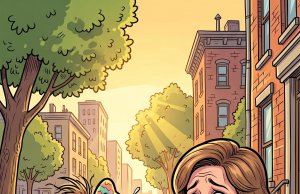
Later, as Silas walked back to his vehicle, he paused at the edge of the curb. Clara was already out on the sidewalk, the bell of her new bike chiming a bright, cheerful melody as she pedaled through the puddles, her laughter echoing off the brick walls. Her mother stood in the doorway, framed by the warmth of the house, watching her daughter with an expression of profound, renewed hope.
The street was still worn, and the house was still modest, but the atmosphere of the neighborhood had been irrevocably altered. A seed of safety had been planted in the cracks of the pavement.
Silas climbed into his car and sat in the quiet interior for several minutes. For most of his life, he had operated under the assumption that true power was a product of fear—that to control the world, one had to silence it. But as he watched the girl wave to him from the sidewalk, he realized that he had been viewing the world through a narrow, hollow lens.
Real power wasn’t found in the ability to take; it was found in the capacity to shield. As he drove away, Silas Thorne didn’t feel like the monster the city whispered about. He felt like a man who finally understood that his strength was only as valuable as the people he chose to lift up with it. And for the first time in years, the silence of the city didn’t feel quite so heavy.