The Silent Custodian
I have just crossed the threshold of my eighteenth year. My name is Brynn.
And the man who maintains the infrastructure of my high school happens to be my father.
His name is Cal.
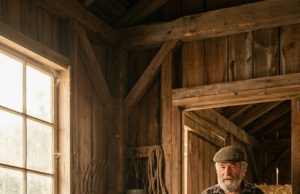
He is the soul who unlocks the heavy glass doors long before the dawn breaks, navigating the corridors while they are still cast in pitch-black silence. He is the one who systematically sanitizes floors that garner attention only when they are stained, revives trash receptacles choked with the discarded remnants of careless days, and mends the physical structures that students fracture in moments of unbridled rage or thoughtlessness.
He lingers long after the stadium lights dim following football games, scraping dried residue from the metal bleachers. He handles the deep sanitation of restrooms that everyone utilizes but no one acknowledges. He replaces the faded bulbs that people only value once the darkness takes over.
And he orchestrates this entire existence in absolute serenity.
Without demanding a spotlight. Without receiving a badge of honor. Without uttering a single grievance.
He is also the anchor of my life.
In a fair world, that realization should have filled me with immense pride. But at fourteen, in the ruthless ecosystem of adolescence, it transformed me into a moving target.
During my freshman year, a boy leaned across the aisle in geometry—his voice intentionally projected to ensure half the room could hear—and asked if my household received “special disposal rights” because my father carried the keys to the dumpster.
The classroom instantly erupted into a chorus of mockery.
I forced a laugh right along with them. Because when you are fourteen and your sternum feels like it is imploding, mimicking the laughter of your tormentors feels infinitely safer than exposing your tears.
Following that afternoon, the name Brynn faded into the background.
I was branded with a new identity: the janitor’s kid.
“The Mop Princess.”
“The Swiffer Maiden.”
One classmate even audibly wondered if my father would be arriving at the spring dance with a plunger in hand.
To them, it was an endless comedy routine.
Every barb felt like a precise, shallow laceration. Not deep enough to sever a vital artery, but enough to ensure I was constantly bleeding out in secret.
I began to physically diminish myself.
I scrubbed every trace of my father from my digital life. If our paths crossed in the bustling hallways between periods, I deliberately slowed my pace or stared intently at my phone screen, fabricating an emergency to avoid walking parallel to him. Occasionally, I would track several paces behind him—harboring the foolish illusion that if I maintained a structural distance, the student body wouldn’t link our genetics.
I despised my own cowardice.
But I was fourteen, paralyzed by the terror of social exile, and desperately clawing for an existence that wasn’t defined by ridicule.
Through it all, my father never once retaliated. Not a single snap.
When the students openly mocked his profession, he simply offered a polite smile and continued his labor. When faculty members conversed over his head as if he were a piece of the furniture, he offered a respectful nod. When a student deliberately upended a soft drink onto a freshly polished corridor, he retrieved his bucket without a solitary sigh.
Yet, within the walls of our home, a different man emerged. Gentler. Whole.
He listened intently to the details of my day. He meticulously prepared my lunches. He folded our laundry while softly humming the traditional melodies my mother used to sing.
My mother’s light went out when I was nine.
From that moment on, we were an isolated unit.
He picked up extra shifts to close the financial gaps. I mastered the art of basic home cooking. We figured out how to exist as a family of two, our lives tightly bound by shared sorrow and predictable routines.
The Question Mark
By the time my senior year rolled around, prom season descended upon the campus like a blinding spotlight I desperately wished to evade.
The girls in my classes spoke incessantly of designer gowns that cost more than our entire monthly grocery allowance. The boys traded logistics regarding limousine rentals and exclusive after-parties. The entire class seemed intoxicated by the anticipation—as if this single dance were absolute validation that their futures were guaranteed to be monumental.
I constructed a defensive wall, telling anyone who asked that I was skipping the event.
“I don’t have time for superficial school dances,” I repeated like a script.
I feigned utter indifference.
Then, on a Tuesday afternoon, my academic counselor signaled for me to stop in the corridor.
“You’re aware that Cal has been pulling grueling hours all week, aren’t you, Brynn?” she inquired softly.
I offered a dismissive shrug. “He’s always the last one to leave the building.”
She shook her head, a soft look in her eyes. “Not like this. He’s been volunteering his personal time to construct the stage framework, wire the lighting, and hang the decorations for your senior prom. He completely refused the overtime compensation.”
She paused, looking directly at me. “He told the administration he was doing it for the kids.”
Later that evening, I walked into the kitchen and found my father hunched over the table, a calculator in his grip and a mountain of bills spread before him. His forehead was creased with that familiar tension he wore whenever he tried to force our finite income to stretch across infinite demands.
“What are you calculating?” I asked, pulling out a chair.
He flinched slightly, instinctively shifting his arm to obscure the notepad. “Just… standard monthly figures, sweetie.”
I sat down anyway, my eyes catching the exposed margin of the paper.
There, scrawled in his precise, labored handwriting, was our reality:
-
Rent
-
Groceries
-
Fuel
-
Utilities
-
Brynn’s dress??
Those double question marks pierced my soul deeper than any locker-room insult ever could.
A profound shift occurred within my chest.
“I’ve changed my mind,” I announced abruptly.
He looked up, blinking in confusion. “Changed your mind about what, Brynn?”
“The dance,” I said, my voice wavering, though I refused to back down. “I want to go to prom.”
For a fleeting second, his expression mirrored a complex tapestry of shock, overwhelming pride—and a sudden, sharp fear. The specific brand of terror that haunts a parent who wishes to grant their child the universe but possesses only a handful of loose change.
“We will find a way,” he promised quietly.
And we did.
The following weekend, we traveled to a charity thrift shop on the opposite side of the county. The air inside was thick with the scent of aged fabric, dust, and hidden potential. We methodically sifted through rack after rack of forgotten garments.
And then, my fingers brushed against it.
A deep sapphire gown. Minimalist. Timeless. The fabric draped over my frame as though it had been tailored specifically for this moment.
When I stepped beyond the curtain of the fitting room, my father froze in his tracks.
“You are the absolute image of your mother,” he whispered, his voice cracking.
The tears threatened to spill right then and there.
Under the Glittering Lights
Prom night arrived with a terrifying velocity.
As I stepped out of the passenger side of my dad’s battered sedan, my pulse hammered in my ears. Almost instantaneously, the familiar whispers drifted through the parking lot.
“Look, it’s the custodian’s daughter.”
I squared my shoulders and forced my feet to move forward.
Inside the gymnasium, the environment was a sensory overload. Shimmering fairy lights draped the ceiling, the bass from the speakers vibrated through the floorboards, and a sea of expensive silk and sequins moved to the rhythm.
And then, my eyes scanned the perimeter and found him.
He was positioned against the back brick wall, clad in an unpretentious black suit that couldn’t quite conceal the heavy, worn work shoes on his feet. In his right hand, he clutched a heavy-duty plastic liner.
Even tonight, he was maintaining the space.
A student standing nearby let out a sharp scoff. “Seriously? Why is the janitor even standing in the room?”
Every ounce of fear and shame that had suppressed my voice for four years dissolved in an instant.
I marched directly toward the elevated DJ booth.
Muted chuckles followed my ascent up the steps. I could feel the collective gaze of my peers burning into my shoulder blades. My hands shook so violently that I had to anchor both fists around the microphone casing to keep it steady.
I tapped the mesh. The music abruptly died.
An eerie, sudden silence blanketed the gymnasium.
I took a deep, grounding breath into my lungs.
“I apologize for the interruption,” I began, my voice trembling over the sound system. “I just… I require a single minute of your time.”
The residual snickers faded into nothingness. The whispers dissolved.
I cast my eyes across the sea of glittering decorations, before locking my gaze onto the solitary figure standing by the exit door.
“The vast majority of the people in this room don’t actually know who I am,” I stated clearly. “Or perhaps you do—but only through a moniker that was never mine to bear.”
A few faces in the front row instantly dropped, staring at the floor.
“For four consecutive years, I haven’t been permitted to just be Brynn. I have been categorized as ‘the janitor’s daughter.’ I’ve been the Mop Princess. The Swiffer Girl. A running joke in the hallways.”
My throat threatened to close up, but I refused to let the silence take over.
“The man standing against the back wall is the identical man who unlocks this entire institution before a single one of us opens our eyes in the morning. He remains here long after the final whistle of our games, long after our dances conclude, absorbing the messes we pretend aren’t our responsibility. He restores what we break. He cleanses what we carelessly leave behind.”
I paused, forcing my eyes to remain anchored directly to his.
“And in all those years, he has never once retaliated. He has never subjected a single student to the humiliation he has quietly endured at our hands. He simply shows up to serve. Every single day without fail.”
I dropped my pitch, letting the raw truth fill the space.
“When my mother passed away, he navigated the wilderness of grief to raise me entirely alone. He packed every lunch. He worked consecutive double shifts to ensure I could maintain my education at this school. And yes—he is working at this very moment. Because even on my prom night, his priority is ensuring the comfort of everyone else.”
The gymnasium was completely devoid of sound.
I swallowed hard, delivering the confession I had carried like a heavy stone for years—steadily, powerfully, and with absolute reverence:
“This custodian is my father. and he will forever be my hero.”
For a suspended heartbeat, no one in the room moved.
Then, the quiet sniffle of a girl near the stage broke the tension. Then another joined.
The heavy silence fractured—not into the cruel laughter of my freshman year, but into a profound, collective realization.
My father stood entirely paralyzed, the plastic trash liner slipping completely from his fingers. His eyes brimmed with tears, and for the first time in my existence, he looked utterly bewildered as to whether he belonged in the room.
I stepped down from the platform, crossed the hardwood floor, and took his calloused hand in mine.
The applause began as a tentative, solitary thud. Then it caught fire. The volume swelled as the entire senior class rose to their feet. Faculty members openly wiped their eyes. A girl who had spent years throwing titles at me covered her face, sobbing in the crowd.
The Shift
The evening didn’t conclude with a simple ovation.
As the high-energy tracks faded into softer, ambient melodies, something far more transformative occurred in the shadows of the gym.
Students began to deliberately seek out my father.
A varsity football player approached, extending a hand in a firm shake. “Hey, sir… thank you for always looking out for us after the home games.” A senior English teacher wrapped her arms around him. “We don’t vocalize our appreciation nearly enough, Cal.” A quiet girl from my homeroom whispered, “My own parents have never shown up to a single school milestone. It means everything that you’re standing in this room tonight.”
My father could only nod, completely overwhelmed by the sudden visibility.
In that beautiful moment, the truth crystallized for me—he had never been invisible to this school. He had simply been unexamined.
We shared a dance. It was slow. Awkward. And absolutely flawless.
Later on, as the remnants of metallic confetti began to clutter the polished floorboards, his muscular memory took over, and his hand instinctively reached toward a stray broom leaning against the wall.
“Dad,” I said softly, placing a hand over his knuckles. “You don’t have to carry that tonight.”
He offered a weary, beautiful smile. “Old habits die hard, Brynn.”
But he let go of the handle.
We walked out into the crisp midnight air as equals. No toxic whispers trailed our footsteps across the blacktop. There was only a sacred, peaceful quiet.
As the engine of the Corolla sputtered to life, he cleared his throat, staring straight ahead at the windshield.
“I had no inkling that you carried that amount of pain, con gái,” he said softly.
“I always knew who you were,” I responded, reaching across the console to touch his arm. “I was just too terrified to say it out loud.”
“I was terrified too,” he admitted.
Years from now, the memory of my thrifted sapphire dress will dissolve. The identity of the DJ and the theme of the decorations will be entirely forgotten by the people who attended.
But I will forever hold onto the exact calendar date when I stopped hiding in the shadows of my father’s profession.
Not because he transitioned into a different career, but because he is a man who executes his labor with absolute dignity, extends a love that demands no conditions, and shows up to stand guard even when the world forgets to applaud.
True heroes don’t require an armor of gold.
Sometimes, they simply carry a mop.